September 16, 2026
Artificial intelligence must be an oxymoron


August 13, 2026
Auckland consumer guide for the sexually active guy (2026 edition)
It has been 13 years since I did the Auckland guide for sexually active guys and a lot has changed with many places closed down.
WINGATE (76 Wingate Street, Avondale, Auckland): The location, facilities and even some of the punters have not changed much over the years. A sprawling Lockwood building in west Auckland includes bath house facilities, communal social area and large garden with spa and (smallish) swimming pool.
The floors around the showers and indoor spa especially need attention. All that constant wetness isn't good, even if the wood is treated. It made for a slightly slippery and uncomfortable feel underneath your feet. Three showers with obscured vision from the spa pool and sauna box, whose inside temperature is searing. The steam room is down some (slippery) steps and can be pitch dark there, which I really dislike. I never try out the spa pool - it's the only aspect of briny bath house culture I prefer stay away from - but it looks quite clean.
The outdoor pool area is its main attraction and a point of difference with all other Auckland venues. Check it out on Google Earth. Punters sprawl around it and soak up the rays on any Summery day. I really mean any day because I have visited on a weekday afternoons before and the place was packed - the quite substantial car parking was full - with gentlemen of a certain age who obviously find that environment way more appealing than having to sit around alone in their retirement home. I can't say whether a different age group, or body type, frequents Wingate on weekends or evenings, you'll have to try it out for yourself (not that I want to sound ageist – I can heartily recommend daddy sex because of all the experience you might learn from). The indoor recreational cruising area is fairly standard: an under-lit maze, small cubicles and a cinema where the seating is very uncomfortable due to straight upright wooden backs. There are two video streams.
In the basement is a large room with couches and (tiny) private cubicles, plus a dark room with floor mattresses for group play.
Wingate is obviously a life's work by the owners. Recommended for a lazy sunny afternoon.
PEACHES & CREAM (474 Karangahape Road, Auckland): The only venue left on K Road, which tells you something about the rapid gentrification of this formerly skid row area.
A large cinema space with a big screen and comfortable, expensive-looking leather seats and couches. It reminded me of an updated version of the former Classic Cinema on Queen Street where the Comedy Club is now. It shows straight porn but don't let that put you off, most of the punters here are after some cock action. But you have to be willing to perform in public, i.e. you may get an audience. There are some private cubicles if you want to watch a film by yourself. There are four cabins available, two of them with interconnecting serving hatches (not glory holes) which you can open or close at will. The toilets are sufficient (if not always spanking clean) but not a pick up or place of action due to the rather harsh lighting.
It’s a relaxing venue and a chance to meet non-scene punters. Great friendly staff at the front desk too (one time I was there the place was attended to by two chatty women who obviously had seen everything before).
THE BASEMENT (Canada Street, off Upper Queen St, Auckland): A sex shop and mail order business but also provides an area for cruising in the back. An ante-room provides space for rest and to get dressed up if you prefer to arrive in civvies. You can check in your valuables.
There is no maze but a series of themed areas for non-vanilla play, including a bath tub and two slings. A few cubicles, a dark ‘groping room’ and a decent size video room with circular seating (instead of rows of chairs) make up the rest. There are two video streams, one on a large, the other on much smaller screens. The toilets are clean and spacious, and towels are for hire.
The venue occasionally hosts private and public parties (check their website for details) which cater for the leather and fetish crowds. It costs more to attend those but they are quite well patronised and good fun as you can turn up dressed as whatever you want to be and realise that long-held fantasy without being judged.
CENTURIAN (NEW ADDRESS: 105 Symonds Street, Grafton, Auckland - in between the Cordis Hotel and Pizza Hut): The venue has relocated to a new space but still quite close to the city centre and it is still a world class bath house. Spacious, clean, catering for a wide variety of relaxation options, including the non-sexual kind - you can just watch Sky Movies/HBO in a sprawling lounge with leather seats or mainstream TV in a little café area, if that takes your fancy but that would be a sign of serious perversion.
All ages and body types can be encountered there. Since it is an inner city venue, it is popular with Asian students, flight attendants, tourists and gym bunnies. But it is eye-wateringly expensive even though the facilities are excellent: it’s clean, the staff are fun and engaging, the steam room first rate in atmosphere and temperature, and the sauna box spacious and hot enough to impress even a Finn. The spa pool is the largest I have ever encountered. There is a maze with whole raft of private spacious rooms with proper, lockable doors. In winter the communal areas and corridors are a little cold due to the lack of heaters in every space. Being formerly a shopping mall doesn't help. The cinema area is a major let down compared to the old venue. The seating is back-less and uncomfortable and there are no sprawling mattresses to relax on.
There a few theme nights, such as no-towel-days, which are a whole heap of fun and should bring out the exhibitionist in you. The atmosphere is far more congenial then, so I would recommend going for those. Orgy nights on the first Thursday of the month can be very busy but expect no privacy: all the cubicle doors are bolted open so expect a crowd to participate in your trading action. When there are a lot of punters, the action opportunities slow right down so you may want to avoid very busy times like Sunday afternoons. There are 130+ lockers, so it does get crowded occasionally.
The major addition is a cafe/bar for socialising, which is a big improvement on the past where alcohol licences were not issued to sex-on-site venues.
LATESHIFT (2/25 Dundonald St, off Basque Road, Auckland): The longest running cruise club in Auckland (even New Zealand). It is a safe, congenial and social place to meet up. The venue hasn't changed much over the years, it is still one of the best to spend a longer time in, such as pulling an all-nighter ‘til the sun comes up, when the drunks barge in from the K Road clubs for some fun at 5am.
There are two well-appointed playrooms available for extra hire charge where you can organise your own private party or, if need be, have a place to sleep. There is one small shower and towels are for hire. The urinal doubles up as a play area. There is a large maze with plenty of cubicles, glory holes and themed play areas (one has a dentist chair, another has a barrel – you get my drift. There is also a video link between two rooms so you can star in each other porn movie). There is an excellent tiered video area where you can watch 6 different video streams, including a straight one, in one go if you don’t want to entertain your neighbour sprawling beside you.
Non-sexual recreation includes a separate video room with Sky movies, a free internet café, a mainstream TV corner and pool table. Plus they cater hot snacks, free coffee and free breakfast on weekends.
Sunday afternoons is Jacks & Jocks, when the venue caters for nude cruising and masturbators.
August 12, 2026
The Stranger / l'Etranger
August 06, 2026
The Fence / Le Cri des Gardes
April 25, 2026
Pillion
March 13, 2025
I read books
Albert Camus’ observations in his collection of essays “Personal Writings” is full of aphorisms and memories, overwhelmingly written in an impressionist style, almost painterly, but as immediately recognisable vignettes. It’s marvelous where he describes his body remembering the height of the steps in his childhood home so he would be able to climb them again confidently in complete darkness (“His very body is impregnated with this house”) – I remember that exactly as well.
His travel writing is similar, with details and impressions of sunlight and its effects in Algiers, Palma and Ibiza – the Mediterranean light having an effect on people who live on its shores everywhere. He is such an inveterate heterosexual (“There are women in Genoa whose smile I loved for a whole morning”) he is not aware of being chatted up (“Some sort of naval officer was belching alcohol-laden compliments into my face”). I don’t have the confidence to read it in French but the English translation is such that you do not notice it is a translation, which is what a proper translation should be.
March 12, 2025
Being a tourist in Greece
February 28, 2025
I read books.
February 26, 2018
LONG FORM TELEVISION
SS-GB
Perfectly bilingual Germans running the UK, giving it the advantages of a European union 30 years early. I like alt-history. There was a little too much trying to be crammed into a 5-episode series. Murder, collaboration, loyalty, resistance, atomic research, House of Cards games, lust, love, betrayal, family, royalty, rivalry. And on the German side, cardboard cliche characters seen in every other British wartime series. Gripping thriller tale but ultimately quite disappointing.
WOLF HALL
What I watched instead of the rugby. "Last night I was in Spain." A true game of thrones where real heads roll. You really have to feel for the people then, afflicted by disease leading to sudden death, famine, lawlessness, poverty, and a lack of everything. And then being saddled by a class system and ruled by an intolerant religion. Nobody got a break then. Incredible acting and clever, thoughtful scripting. It's Mark Rylance's masterpiece as Cromwell, but Anton Lesser as Sir Thomas More plays him as the creepiest fundamentalist you do not want to come across. Highly recommended.
BROEN /THE BRIDGE
Swedish is definitely far easier to understand than Danish. With these Scandi-noir series it's hard to understand how the Scandinavians manage to be ranked the happiest people on earth. But I like Saga Noren, the Swedish protagonist, especially for her refreshing attitude to sex. (She's puzzled why an occasional shag wants to take her out for dinner since she always presumed that that was a prelude to and gambit for sex, not the other way round). Highly recommended, not just for the strong story and acting but the Swedish/Danish humour, which is very droll. The language games will appeal to your inner Aspie. And it was deep into season three before they realised you can draw curtains.
FORBRYDSELEN / THE KILLING
Cold, dark, windy, wet, wintry New Zealand, so what better time to watch a cold, dark, wet, windy, wintry Copenhagen doing its utmost to dispel that hygge trendiness in a superb scandi-noir Forbrydelsen series full of secrets, lies and political Machiavellianism. I just love the ribbing between the Scandinavians. Danish is pretty easy to pick up. Just mumble and they'll understand you fine. And what do I like about Denmark? The second-in-command at an army base showers with his troops in a communal bath house. When naked, the real men get sorted from the boys.
SPRINGFLODEN
Typical Scandi-noir gruesome murder case with quirky details, such as a police academy student driving a vintage convertible Mustang - in Stockholm weather! - and a sassy gay sidekick. That was a marvellously rich and surprising story. Highly recommended.
ÄNGELBY
Twin Peaks-esque Swedish mystery series, but probably a little too Catholic for Lynch fans, I think. Too much about the eternal fight between good and evil, but it has also a philosophizing police officer with a space cadet deputy, and witches and trolls (of the original Nordic kind). And pinetree woods, of course. I like a language that has the same word for 'hello' and 'bye'. Set in small town Sweden there are no traces of Ikea or H&M.
THE HANDMAID’S TALE
Time to take a break from Scandi-crime and move to the American dystopia of the Handmaid's Tale. The women get a rough deal, and the men aren't living in paradise either.
The politology. It's interesting to speculate how that dystopian society came about. I read the novel was written in 1986, way before the internet, cellphones and social media. It feels odd to have savvy strong female characters (before the change to the totalitarian regime) being totally unaware that a coup d'état by Christianists was in train.
The theocracy. Which religion actually rules in Gilead, and how did it get rid of its rivals? It seems a Protestant strand is dominant, not the Catholic Church. What happened to it, and how? What happened to the other sects, and other religions, and atheists? One executed prisoner wore a Star of David on his mask, so I presume Jewish people were part of the extermination, Nazi-style, alongside the gays and political resistance.
Gilead seems to have an excellent health service. How did they get there after Obamacare? Gynaecological services provided by men still?
It's mentioned that there are only two remaining states of the USA, with the capital (highly improbably, considering how Republican it is) in Alaska. I presume the other one is Hawaii. How did the Democratic east and west coasts get conquered? If Gilead covers all 48 continental states, I think this is a major flaw in the story, as the USA would have ceased to exist sooner and have split up along red/blue state lines.
The economy. Did the author seriously think the Gilead economy would not collapse when the whole female workforce was dismissed and had no access to bank services? (How do single females pay rent/mortgage/loans?) Where are the corporations and media? It is assumed they have had no power in stopping that economic suicide.
I like overthinking my dystopias. Dystopian visions are a challenge, like murder mysteries and crosswords. You want to unravel them, as a sport. All dystopian stories (like utopian and sci-fi ones) reflect the anxieties and hopes of the times they have been conceived in, be it More's anti-reformation dreams, Orwell's totalitarian nightmare in 1948, Star Trek in the hippie 1960s and beyond, and, in this case, Atwood's mid-1980s, before the Cold War ended, when digital technology still was in its infancy, and social control really needed brutal repressive force.
The gloryhole in the girls' toilet made me lol.
Aunt Lydia. She's a survivor too, just with a different strategy. She's straight out of "Mädchen in Uniform". The overarching story is about hypocrisy: of the men, of the women, of the religion, of the ideology.
DEUTSCHLAND ‘83
From a hysterical dystopian breakdown in the US, now on to the good old days, when capitalists were confident and communists were too. Deutschland 83, a German twinky James Bond without the gadgets but with a terrific nostalgic early 80s soundtrack. And I never knew East German girls were that easy, skinny-dipping with their boyfriends' best friends! Absolutely enjoyable rollicking ride. I remember the Reagan-era deployment of Persching missiles in Belgium too, with all the attendant protests. Also the East German atmosphere was spot on. When travelling there in 1982, the border crossing was exactly like that - the angry-looking border officers welcome, the rifling through your backpack for forbidden literature, the enforced money exchange, the crumbling houses (very picturesque though, compared to the West German garishness). Another tale of deception and hypocrisy: everybody knew the DDR was fantasyland, everybody watched West German TV, and danced to the same pop tunes. The AIDS sub-story was poignant and a great reminder how terrifying it was.
ABER | BERGEN
Time to brush up my Norwegian with Aber | Bergen. Thankfully they got the joke about Bergen and the rain out of the way in the first 15 minutes.
LOCH NESS
Attempt at Scottish scandi-noir, complete with inventive murder motivations, but with over-bearing DCI in hock with trendy criminal psychologists, goes on and on a bit. A serial killer obsessed with body parts, bumping off gay and bi-polar characters, and you know he's had a lousy childhood and daddy issues. Gorgeous scenery, of course, but really not in the must-have-seen-this-before-you-die category. Hot trivia bit: the PC whom the camera often lingers over a little too often and too long is playing Prince Harry in a Windsor-Markle love epic.
MIDNATTSSOL / MIDNIGHT SUN
Back to Sweden/Sapmi, another gruesome serial killer series where the sun never sets. Written by the guys who brought us The Bridge, it has its customary cruelly inventive grisly murder scenes, police officers with issues, iron ore miners in underpants, cultural and political clashes between Swedes, French, and Sami. And best of all, five different languages spoken. The skies of Kiruna are magic. It never gets dark in the whole series, except when going down the mine. Recommended.
CODE 37: SEX CRIMES
Binge-watching is the current pastime, of course, so I chose a Belgian crime series set in Ghent, the city where I am from but don't have a huge link with since I had left it at age 5.'Code 37' is a fairly formulaic cop series featuring a vice squad headed by a female with a troubled past and her team of 'hardened' (but verging on gormless) males - so far so familiar. Cop show standard gruesomeness and humour ("Therrre's been a murrrrderrrr") are here replaced by rather gratuitous and superficial portrayal of the 'sex crimes' without much psychologising or illumination of motive, impact or consequences.But I learned a few things: who knew exhibitionism and voyeurism are criminal offences (even when consensual)? Some marvellous guest roles - the skinny whore john speaking with a proper Ghentian accent had me in stitches - including my old friend Frank Vercruyssen playing a porn director.
MADAME K.
What an opportunity to watch a TV series with international appeal in the Estonian language. "Madame K" is set in an upmarket Tallinn brothel on the eve of Estonia being smashed between a very hard rock (Nazi Germany) and a very hard place (Stalin's Russia).
The series could be set on a single theatrical stage but the themes, politics and personal dilemmas are vast. Being in a small country about to be occupied, razed and dismembered, your choices and options to survive are vanishing before your eyes: either be deported to the Soviet gulags or enlisted into the Wehrmacht, with fleeing to either brave Finland or neutral Sweden, both across treacherous waters, not really on offer - and recently fallen France, Britain fighting for its own survival, and an America not really interested in another European war, are well out of the picture.
All a very fascinating backdrop to this charming, leisurely-paced series where they don't hold back philosophizing about love in a brothel and geo-politics (with both intertwining when entertaining American spies and Russian soldiers alike). And it's done on a shoestring budget, with their cash spent on charming period heirlooms, appliances, cars and costumes - who knew Estonians ate waffles so often for breakfast?
AMSTERDAM UNDERCOVER
Started watching Amsterdam Undercover but had to stop mid-way episode 1 when our undercover German cop arranged a meeting with his mole at the Rijksmuseum in front of Rembrandt's Night Watch. He was the only viewer. This kind of dissing Rembrandt (and the Dutch, for the whole cast speaks German, not a word of the native tongue is heard in Wunderschön Amsterdam) cannot be allowed.
And on a wider point: whole cop series drama tropes would be wiped out if the drugs trade was legal.
FENIX
Dutch-Belgian cop series so you know the language will be vaguely cross-border Brabantian. A bit noir-ish (maybe call it 'polderdark'), even Shakespearean, slow but often a terrific ride through travellers' blood-is-not-always-thicker-than-water families, drugs manufacturing and trade, Jewish blackmail and political corruption.
Pity Teun Luijkx never took off his shirt properly in this too-short series but there were some laugh-out-loud moments in very dark humour corners involving morgues, uncircumcised corpses, and diamonds (don't ask).
REKYL / RECOIL
Up north again, this time to monochrome, gloomy, overcast Oslo, where drug-smuggling low life meets corrupt police and the exploitation of the Norwegian version of the Resource Management Act, and where everybody is cynical and devoid of any trust. It has the obligatory digs at the Swedes, but who knew Norwegian men, even after scoring a hot date, always slept with their underpants on?
STANDING TALL
South this weekend, to Rome, Anzio and Ostia, with a refreshing if terribly sad tale that is not focusing on Italian crime tropes like the Mafia and corrupt policemen - although there are some references to them - but on forces that tear a society apart more effectively than those. I'm not giving away anything more because that would be spoiling the plot, just mentioning that using the victim as a Greek chorus to the whole plot is a wonderful dramatic device.
The series is gorgeously filmed, seamlessly jumping between cinematic scopes, drone vistas, hand-held camera close-ups and grainy flashback footage that actually looks 10 years old. And with Rome as you not often see as a backdrop providing grittiness and community.
It is a feature in many a series I've watched so far that urban icons, such as trams or trains, function as an identity for where you are supposed to be immersed in as a viewer, be it Copenhagen, Oslo, Ghent, or Rome, despite none of the characters ever taking public transport. Cars, roads, and motorways are simply too ubiquitous and nondescript to provide any socio-geographical information.
NåR STøVET HAR LAGT SIG
"When the Dust Settles" is about post-traumatic stress disorder affecting multiple direct and indirect victims of a random terror attack in Copenhagen. It's an ambitious and harrowing portrayal of how a random group of people from all walks of life, from homeless single mothers to justice ministers, from plumbers to Danish Muslims, from Swedish singers to Greenlandic chefs, are trying, failing and succeeding in coming to terms with both a collective and individual experience. Copenhagen seems like a small village where everybody is connected through almost random but also meaningful meeting points, it could be just like real life but here crystallized by a single central event. Not easy to watch people falling apart and putting themselves together again. The gay Muslim seduction scene was sweet and funny but you just knew that was not to be. The putting down of the dog was callous and unbearable.
MUSTA VALO
Time to brush up my Finnish with "A Good Family", a rather implausible but still amusing tale of cops, drug dealers, wayward sons, gangster dads and cop mums in Helsinki, which looks like Auckland but mostly in the dark (it also has a gorgeous harbour with little islands to go on holiday to). The city must be small enough for everybody to know each other, especially the baddies and the cops, which makes for interesting family politics combined with corruption. After the first episode you never notice it is barely ever not dark in the streets, guns are everywhere and illegal drugs are at the root of all social evils.
THE KING
When you read this, at this very moment, you are at the current endpoint of your life choices' stream options you have made so far.
No matter who, what, where, how or why your are, there you are. You may be a prison governor or guard, or even an inmate a, drug dealer, an oncologist or a chain-smoking detective, a Moroccan Milanesian or a Quran-thumping fundamentalist.
This is the premise of Il Re ("The King"), a superb series set in San Michele prison, which is but a stage for a condensed version of today's Italy. Picture it: theoretical but also theatrical 'rule of law' proponents set against an assault by corrupt or corruptible state officials with an the assortment of secular and religious criminals. Who ends up in what role on which side of the fence is completely dependent on the actions and choices the individual has made in their life so far.
We're all born in a prison but some of us want to get out.
Focus of this story is, naturally, the title character, Bruno Testori played by Luca Zingaretti, so we're largely asked to view everything while performing his job as King or Duce running the prison, keeping his team ("Praetorian Guard" - not the only reference to Roman times) onside, bamboozling police and secret service, and investigating escape shenanigans, on top of dealing with family affairs and a coke addiction.
Why anybody would choose that life path is beyond me but I demand Zingaretti is cast as Mussolini in his biopic.
May 24, 2017
L'inconnu du lac / Stranger by the Lake

One hundred per cent filmed outdoors, with a cast which needed no wardrobe, it had the air of a nature documentary in which David Attenborough stumbles across a pair of gay men getting it on in the bushes, but instead of suavely narrating off-screen, being firmly told by the subjects of his voyeurism to go jerk off elsewhere, like the on-looking wanker was.
The story line is thrillingly Hitchcockian, complete with a shocking murder scene filmed in one take and from a far distance, but without a happy ending or release. But the real story is one of complete callousness and solipsism of all men involved, who have no regard or respect for the murder victim and blithely carry on as nothing had happened. As the main character said: "Life goes on."
Eros and thanatos, sex and death, are closely linked in this film, and not just from the amount of unsafe sex that went on. Having a psychopathic killer who thinks nothing of getting rid of a clinging 'boyfriend' by casually drowning him is one thing, but one that thinks he can get away with multiple murders without any consequences due to the inability and unwillingness of the 'community' present at the lakeside to intervene or co-operate to solve the crimes, is an indictment.
No names are known or mentioned until halfway through the movie, a familiar occurrence when you frequent gay cruising places or venues. I always thought how easy it would be for a murder to be committed at such sites without anyone, even witnesses, knowing anyone's name or business.
The policeman in the film, incidentally the only person fully clothed, had the unenviable task of piecing it all together, and, even more importantly, he is also the Greek chorus commenting on the aspects of cruising culture that many gay men willfully ignore. Being held a mirror to your own culture can be shockingly revealing.
Highly recommended viewing.
February 19, 2017
Alternative Ulster
May 03, 2016
Groundhog Day
The golden weather after 18 months of improvements in services on the Waiheke ferry has come to an abrupt end when Explore Ferries decided to pull the plug on its sailings from 8 May. It cited lack of patronage which would not enable them to get through the Winter.
But this simple reason masks a multitude of systemic failures in the Auckland ferry scene, and if they are not remedied we will unlikely see any competing service ever again. This might suit Fullers' shareholders and cashflow very much, but it is an unsatisfactory state of affairs for passengers who can now only look forward to the resumption of the old service attitudes and upped fares. The public transport regulator, AT, is happy to look the other way because it cannot afford to offend Fullers, lest they would need to fund a ferry service themselves and that is the last thing they want to happen.
This blatant favoritism of AT for the incumbent was obvious from the start:
- Explore was forced to dock at Pier 3 - while Pier 2 and Pier 4 were upgraded in no time (for the exclusive use of Fullers).
- At all times AT inspectors were present at Pier 3 to see whether Explore staff made any mistakes. Any passenger reaction and complaints about the conditions Explore had to work under was immediately used as a stick to beat Explore with.
- The ticket booth was miles away from Pier 3 and at Matiatia better hidden than the toilets.
- The exempt service let Fullers double its sailings at short notice and even when they could not meet their own timetable, nothing was or could be done to hold them accountable.
- The extension of the supergold card loot was delayed for over a year, and when Explore offered passage for free in the meantime, nothing was done to make payment retroactive, i.e. make Fullers hand over part of the cash as they did not transport all pensioners as claimed between Auckland and Waiheke.
- Preventing Explore from running a bus service on Waiheke, or even specifying in the Waiheke Bus contract all buses on Waiheke should meet all services, resulting in a useless service to and from Explore sailings (Fullers causing chaos for its own bus services after introducing a half hour service was left unexamined or cared about).
It is now up to politicians at all levels to remedy this market failure and tackle this private monopoly head on with some urgency. The Local Board needs to lobby all players involved to ensure a satisfying outcome for islanders and visitors alike. City Councillors need to seriously look at the dysfunction, incompetence and obvious favouritism at Auckland Transport. National politicians need to abolish the 'exempt status' of Fullers and bring it under the umbrella of the PTOM system, so services can be regulated, in case it remains a monopoly, or tendered for, in case there are other companies interested in providing the service.
August 24, 2015
No sex, but plenty of violence
It was strange that in the midst of an environmental disaster and resource wars everybody drives these gas guzzling vehicles. Oil was obviously not in short supply. I suppose the pyrotechnics would have been limited if everybody was on push bikes. Also, there were no non-whites in the cast, as far as I could see under the dusty and pasty faces. Was there any reason for this, apart from appealing to adolescent white males who are into heavy metal culture? And there was no sex, no nudity, no kissing. Just violence. The would-be censors might have to revise the "sex & violence" meme. Plenty of body fluids though - blood, spit, breast milk - but strangely enough, no semen. There was a caesarian birth but the actual scene was not shown - I guess some things were a step too far for its target audience! (The umbilical cord twirling doctor was the obviously token gay character in the film).
October 21, 2013
Sex in the news
 "21-year-old Daniel McDonald, has been linked to another sex scandal. He
is expected to face disciplinary measures as the founding member of The
Love of my Life, an AFDA football group that made new members perform
sexual acts on one another as part of a hazing ritual."
"21-year-old Daniel McDonald, has been linked to another sex scandal. He
is expected to face disciplinary measures as the founding member of The
Love of my Life, an AFDA football group that made new members perform
sexual acts on one another as part of a hazing ritual."But why that should not be a scandal, let alone an offence, is made clear:
"[...] while McDonald was a founding member of the group, no criminal offence had been committed by the participating males."
The earlier case refers to him showing off to his mates in a heterosexual Skype show:
"Daniel McDonald, now 21, and Dylan Deblaquiere, 20, faced the ACT Supreme Court on Monday for a sentencing hearing over the 2011 sex scandal at Canberra's Australian Defence Force Academy (ADFA).
McDonald had sex with a fellow female military recruit in March 2011 and broadcast it live on Skype to Deblaquiere's room where other male cadets watched.
In August, both were found guilty of using a carriage service in an offensive manner and McDonald was also found guilty of committing an act of indecency."
August 10, 2013
An Artful Dodger's musing
Do we look at the world – and art – differently because of our sexual orientation?
Imagine, if you will, wandering into an art gallery or museum, not knowing what to expect or see, perhaps enticed by a specially curated exhibition of art you are rather unfamiliar with. It’s something that may occur frequently, especially on travels when you want to see what the locals have made or collected. It happened to me last year when visiting the Auckland Art Gallery’s exhibition of work owned by the National Galleries of Scotland; the appealingly human-scaled Berlin art museums; and the renaissance treasure troves of the Low Countries.
I’m not a huge art connoisseur – I like to be surprised, appalled or seduced by each painting and sculpture that crosses my path through an exhibit, even to the point of ignoring who the artist is or what the work is called. I regard wandering through an art gallery akin to an adventure trail with no set path, signs or finish. A complete open-mindedness when approaching a piece of work has, in my experience, always stood me in good stead and allowed me to be able to enjoy the art – even the disappointments. Contemplating a painting that draws you in, screws your brain and leaves you pleasantly exhausted is almost as good as having mind-blowing sex.
I would like to think that the way art speaks to people is somehow related to their sexuality and sensibility. I love hearing a lesbian’s assessment of a Tom of Finland drawing or a straight man’s eulogy of the female nude in Western painting, then trying to relate those criticisms to my own. On a related but different level, I would hypothesize that many collections around the globe might have contained very different pieces if their investors/collectors had not been gay men or lesbians. And does this mean that my distinct lack of enjoyment of the aforementioned Scottish exhibition, despite its critical acclaim in the local media, is due to my gay sensibility second-rating many of the works? One often knows more about the artist’s inclinations than the critic’s.
For those lucky enough not to have studied for a fine arts degree, like me, there are some excellent art historians and critics around who have produced sterling guiding work for television. Sister Wendy’s roaringly funny and touching reflections on art, particularly religious art, and Kenneth Clark’s Civilisation have both given me the confidence to look at art with all my senses and judging faculties, and being unafraid of going against the received wisdom of the art canon.
 On BBC World News, Andrew Graham-Dixon is a leading light
when it comes to letting you see art in an unexpected sociological and
national historical setting. He did a series on Russian and German art
and his take on art in the Low Countries is on the Arts Channel.
His previous work included a riveting piece on Caravaggio’s
relationship between the artist’s biography and his art, which was
especially appealing to a gay guy like me after Derek Jarman’s earlier
magisterial and idiosyncratic treatment of Caravaggio’s life. And
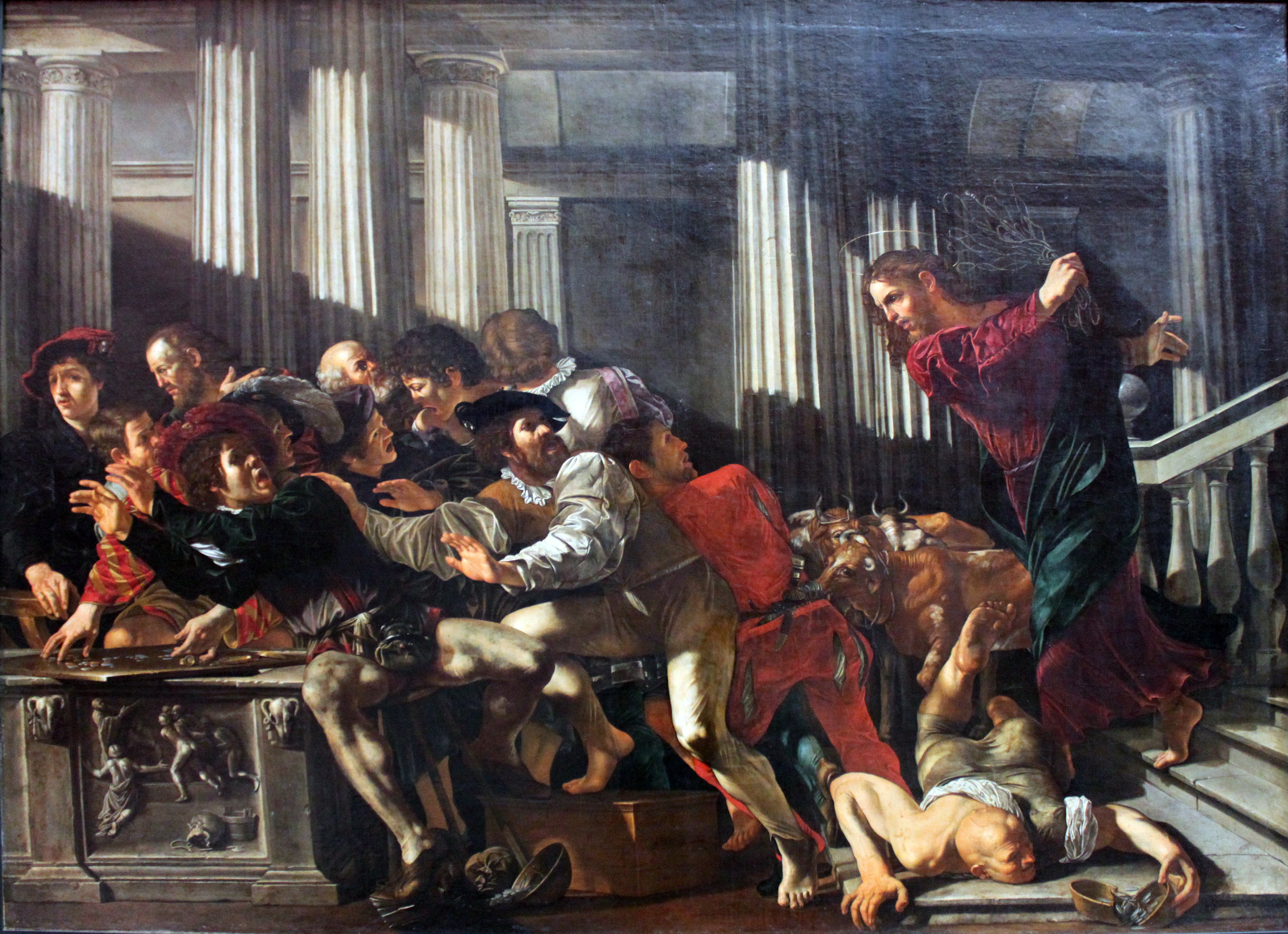
nothing, of course, beats standing in front of “Christ Expulses the Money Changers Out of the Temple” or “Triumphant Eros” at the Gemäldegalerie in Berlin.
On BBC World News, Andrew Graham-Dixon is a leading light
when it comes to letting you see art in an unexpected sociological and
national historical setting. He did a series on Russian and German art
and his take on art in the Low Countries is on the Arts Channel.
His previous work included a riveting piece on Caravaggio’s
relationship between the artist’s biography and his art, which was
especially appealing to a gay guy like me after Derek Jarman’s earlier
magisterial and idiosyncratic treatment of Caravaggio’s life. And
nothing, of course, beats standing in front of “Christ Expulses the Money Changers Out of the Temple” or “Triumphant Eros” at the Gemäldegalerie in Berlin.Simon Schama has produced an intensely personal take on artists as varied as Rembrandt, David and Rothko in his Power of Art series on BBC Knowledge, which smacks you round the head with its erudition and often far-fetched theorising. He nevertheless remains enjoyable because the show allows you to talk back afterwards, if you’re keen enough to delve into the subject’s art yourself.
None of those television personalities, as far as I know, are gay. So I am again intrigued whether critics of a different sexual orientation would approach Bernini, Friedrich or Hirst differently.
Re-interpreting imagery, storylines, characters and quotations is what we are really good at. Whole pre-gay liberation movements have devoted their waking hours to appropriating actresses, films and operas, resulting in whole swags of cultural icons and artefacts now being recognised as ‘gay culture’ which every aspiring queen needs to master. The beauty is that this gay subcultural conquest is on-going, even though it is becoming less easy to find material since show business and other visual arts are now actively niche-marketed to us instead of invented by us.
We just like to dance to our own tune and dream the world as we want.
July 30, 2013
The 2013 update of the Auckland Consumer Guide for the Sexually Active Guy
July 21, 2013
Gay Abandon
April 20, 2013
Mighty River Power share sale
April 15, 2013
Waiheke Island election candidate selection
March 26, 2013
If...
Lindsay Anderson's "If... " doesn't depart from that template but the difference is that all those strictures are the film's main subject rather than its background to another story (as in, for instance "Another Country"). Malcolm McDowell's character resistance is existential rather than political and there was something marvellously 1960s about the movie, with its trippy escape into town ("out of bounds!"), street theatre and a joyride on a stolen motorbike, the hook up with the cafeteria girl and the dreams of free love.
The ending is a little disappointing due to the cop-out into violence - the Sixties' hedonist culture did at the time reverberate through even the stodgiest of social institutions, for a while at least.
The film switches back and forth between colour and black & white film stock, which gives it an alienating and interesting feel. (Prosaically, this was due to budget restrictions forcing some scenes to be filmed in black and white for technical reasons).
Marvellous sound track with Sanctus from Missa Luba: